
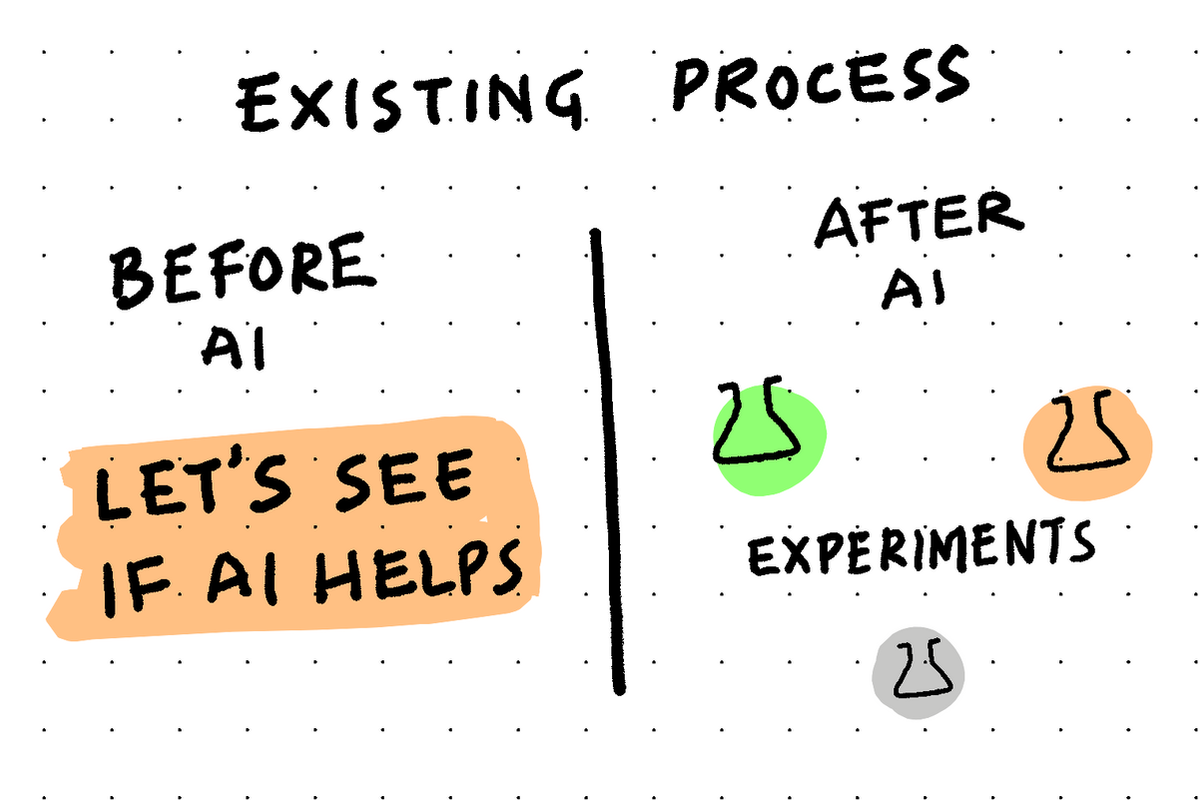
Rapid and disciplined experimentation is becoming a strategic necessity in AI use cases across healthcare, finance, insurance, and commerce and those that invest in AI experiments with a clear set of business outcomes win.
Here are 9 reasons teams build and deploy AI solutions in enterprise
- Increase Individual/Team Productivity
- Reduce Human Task Hours
- Automate Routine/Repetitive Work
- Increase Customer Satisfaction
- Reduce Human Training
- Novel Technology Solutions
- Reduce Interdisciplinary Expertise
- Faster Failure Response Time
- De-Risk Plan
AI scales when systems understand intent, not just prompts.
This post explains how enterprises can set up experiments to develop AI solutions. It covers practical steps, examples, and tips to create a culture of experimentation that drives meaningful AI innovation.
Why Experimentation Matters for AI in Enterprises
AI projects often fail because it's not clear how teams will adopt gen AI, teams face challenges: wait for more clarity and risk falling behind.
Enterprises face unique hurdles:
- Complex legacy systems
- Diverse data sources
- High stakes for errors
- Need for cross-team collaboration
The Path Ahead
Don't treat GenAI adoption as a yes/no success question.
Instead, run deliberate experiments that help your business and engineering teams understand cause and effect.
- Problem: Pressing Customer Problems—Design experiments around a customer need. This prevents random AI pilots with unclear value.
- Experiment: Structured Approach: Control vs AI-assisted workflows, Persona-specific trials (e.g., Sales Manager vs Ops), Phased rollout with clear hypotheses
- Learn: Systematic: insights you get—For whom GenAI works, Where it fails, What design or data constraints matter
Experimentation helps by breaking down AI development into manageable tests. These tests validate ideas early, reduce risk, and provide clear evidence for decision-making. Instead of guessing, teams learn from data and adapt quickly.

Move from AI Pilots to scalable systems using the Intent-Aware Experiences (IAE) Framework
Intent-Aware Experiences simply gives you a structure to carry the experiments forward and apply them in your own organization.
Why IAE Framework matters for enterprise?
- Turns agentic AI chaos into persona-centered conversations
- Scales from AI pilots → enterprise systems
- Aligns UX, governance, and business outcomes
Works especially well for:
- Enterprise workflows
- Regulated industries
- Multi-agent systems
- Decision-heavy roles
IAE works for Portfolio of Organizational Experiments too.
Let's walk through it.
- Intent: Signals — What's the user trying to do?
- Intent: Transitions — Who decides here?
- Intent: Literacy — Can users trust this?
- Intent: Performance — How do we know this worked?
Step 1: Intent: Signals
Design AI based on the user and what they're trying to do and how risky it is. So with segmenting users, try to divide intent signals into following three categories. Example user grouping: Sales Manager, Support Agent or Admin
Three Types of Intent Signals
- Explicit Intent: What user asks for—They ask a question, They click a button, They give a command. Example: Why did our pipeline drop for Q4FY25? Approve this renewal for account.
- Implicit Intent: What behavior tells us—They keep checking the same report, They log in late at night before a deadline, They hover over a decision but don't click, They jump between screens. This usually means: I'm unsure. I'm under pressure. I need help but don't know what to ask.
- Risk Sensitive Intent: Some actions can't be undone—Approving prices, Sending customer communications, Submitting compliance reports, Making financial commitments. You can decide: When AI should suggest, When AI can act, When AI must pause and ask for confirmation
How this helps teams set up AI experiment
- Start with a small set of high-value interactions
- Classify intent by risk and consequence
- Assign AI role intentionally: Augment → suggest, summarize, explain; Delegate → handles the simple workflows and asks for help on the rest; Automate → runs it on its own and leaves breadcrumbs
How this supports experiment for when 10 people use it
- Teams can test AI in low-risk, augmentative modes
- Governance is embedded from day one
- If you can't redesign entire workflows, make them smarter
How this prepares for when 10,000 people use it
- The system clearly understands what the user is trying to do, not just what button they clicked.
- Rules don't live in people's heads or training documents the system follows them automatically. Allows user to add new rules as they continue working with different customers.
- Agent behavior remains predictable when usage spikes like quarter-end or incident response.
Using AI systems can reduce siloed thinking. Equips individuals from different departments to come together as a team.

Step 2: Intent: Transitions
Enterprise advantage
AI changes who decides, often invisibly.
Intent Transitions make decision hand-offs:
- Explicit: The product shows: AI is suggesting, You are approving, This requires review. No silent decisions. Later, anyone can see
- Designed: We intentionally design: Where AI stops, Where humans step in, What triggers escalation. Design responsibility the same way we design flows.
- Auditable: What the AI suggested, What the human approved, What was escalated and why. You can explain decisions, not defend them.
How this helps teams run experiments
- Identify points where intent escalates
- Design UI Design System for: Recommendation, Confirmation, Override
Observe friction, hesitation, and overrides
Engines of learning and adoption
- Compare Groups of People: Run the experiment for weeks or months to capture initial and long term effects. Treatment Group: Teams using AI system. Control Group: Working as usual without the new system.
- Random Assignment: Conduct controlled experiments in which team members are randomly assigned to their tasks manually or with AI assistants. Track AI tool's effect on performance and related metrics like job satisfaction, job experience and mental strain.
- Staggered Roll-outs: Phase a release in to different teams over time
- Lab in the field: Monitored environment where user interactions with new system is observed.
Build organizational momentum for change. Partner with early adopters, show frequent progress, get feedback on prototypes.
Step 3: Intent: Literacy
Enterprise advantage
Experiments help leaders spot hurdles before going with the full scale rollout. Like when AI tools generate hallucinations and unreliable results it impacts adoption.
Intent: Literacy focuses on teaching
- Avoid False Positives: Ensure that initial positive results aren't just a fluke
- Understand Your Audience: Avoid the risk that a workflow automation is useful for just one person
- Assess the scalability: Ensure that new initiative's success is not based on one person
- Consider Unforeseen Effects: Be aware of the negative impact from unforeseen issues from scaling
- Manage Costs: Regularly see if the costs of the initiative are sustainable
How this helps teams experiment
- Teams are pushed to focus on guiding questions
- Teams adopt a structured way to navigate the problem space
- Trial and error methodology give view of primary and secondary effects of AI system. For example: A manufacturing giant found AI helped reduce shop floor workers reliance on expert engineers.
How this prepares for scale
Teams can reach out to conduct experiments with prospective buyers.
Adoption through AI experiments reinforces existing relationship and create new ones.
Step 4: Intent: Performance
Enterprise advantage
Measure how good the decisions were.
Intent: From activity metrics to outcome clarity
- Instead of asking "How many tasks were completed?" ask "Did the right decisions get made?" Example: Instead of counting closed tickets. Measure how many were resolved correctly the first time.
- Instead of asking "How fast was this done?" ask "How quickly did we reach confidence?" Example: AI drafts a report in a few minutes. Track how long it took the user to approve it.
- Instead of asking "Did the team use the AI tool?" ask "Did AI improve outcomes?" Example: Instead of adoption rate. Track reduction in rework and time saved.
- Instead of asking "How often did AI act automatically?" ask "When was human judgement applied effectively?" Example: Log overrides and analyze whether human intervention improved final outcomes
- Instead of asking "Did throughput increase?" ask "Did errors decrease?" Example: AI speeds up invoicing. Measure reduction in billing discrepancy.
How this helps teams evaluate experiments
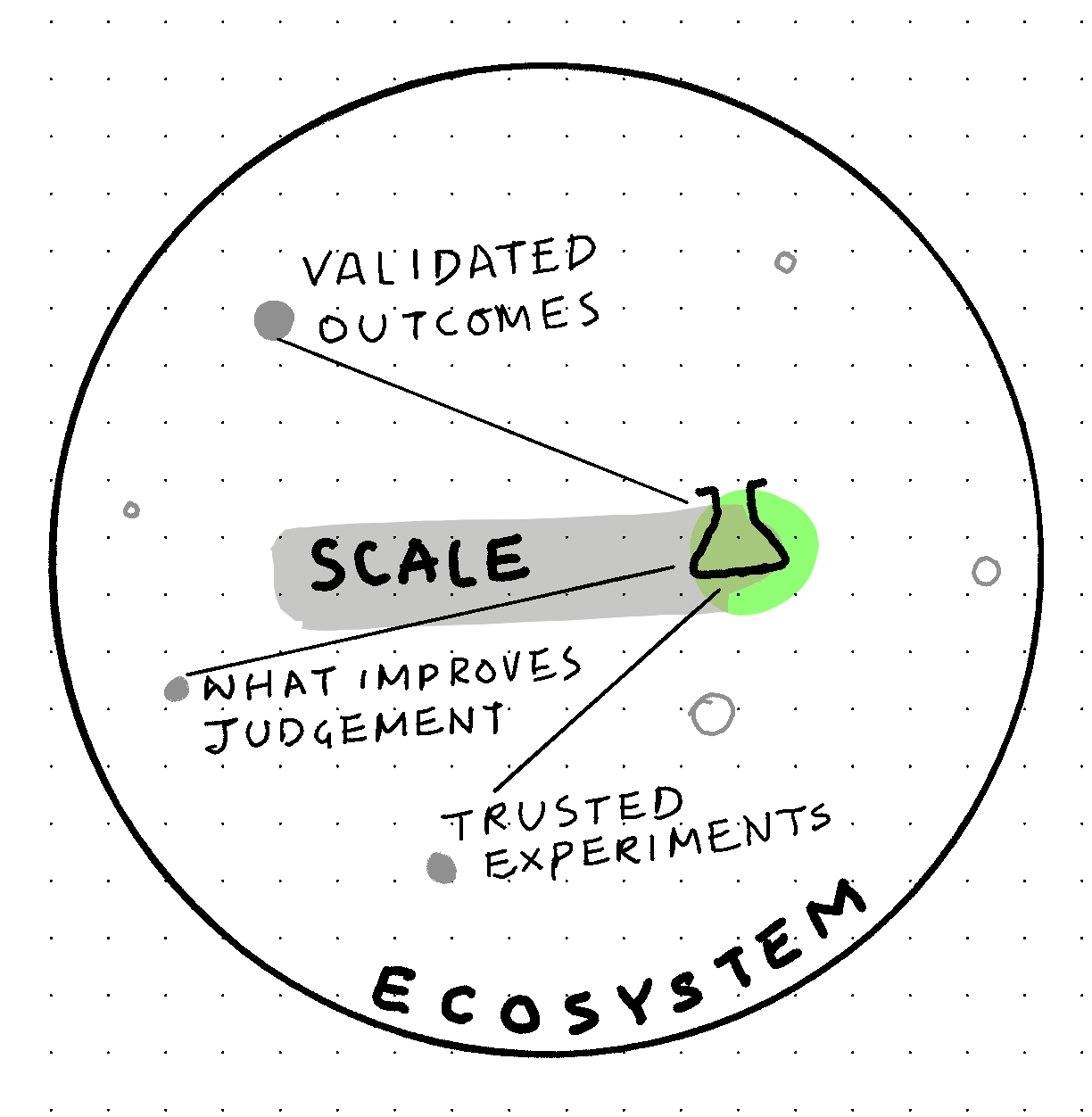
Scale measured outcomes into the ecosystem
AI's true economic potential lies in creating entirely new systems of value.
Required Collaboration Capabilities
AI experiments require diverse skills. Assemble a team that includes:
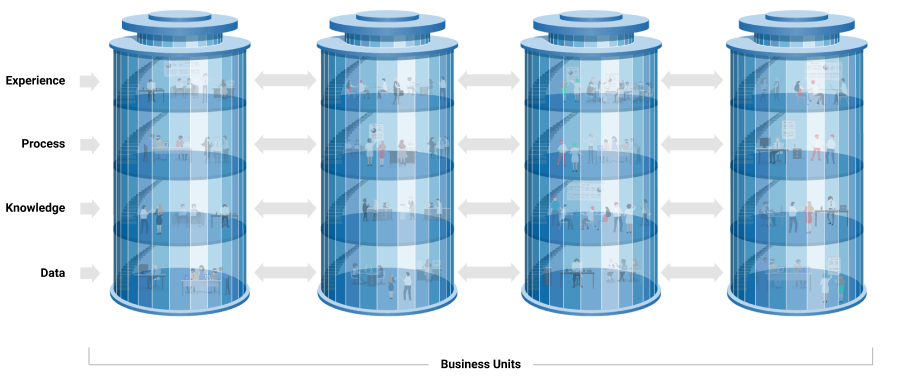
- In-house cross-functional team
- Customers
- Industry Experts
- Academics
- Suppliers
This mix ensures experiments are grounded in real needs and technically feasible. Collaboration also speeds up problem-solving and knowledge sharing.
Start Small with Minimum Viable Experiments
Avoid building full AI systems upfront. Instead, create minimum viable experiments (MVEs) that test core assumptions with minimal effort.
- Who: Internal/External Users
- Benefit: What is the Benefit
- When: How Quickly
- Re-design: Workflows, Tasks or Skills
Disciplined experimentation, guided by the Intent-Aware Framework, turns AI from a risk into a strategic capability. Facilitating organizations to scale measured outcomes and actively shape the future of ecosystem.
AI ExperimentsIntent Aware Framework (IAE)Innovative UX Strategies